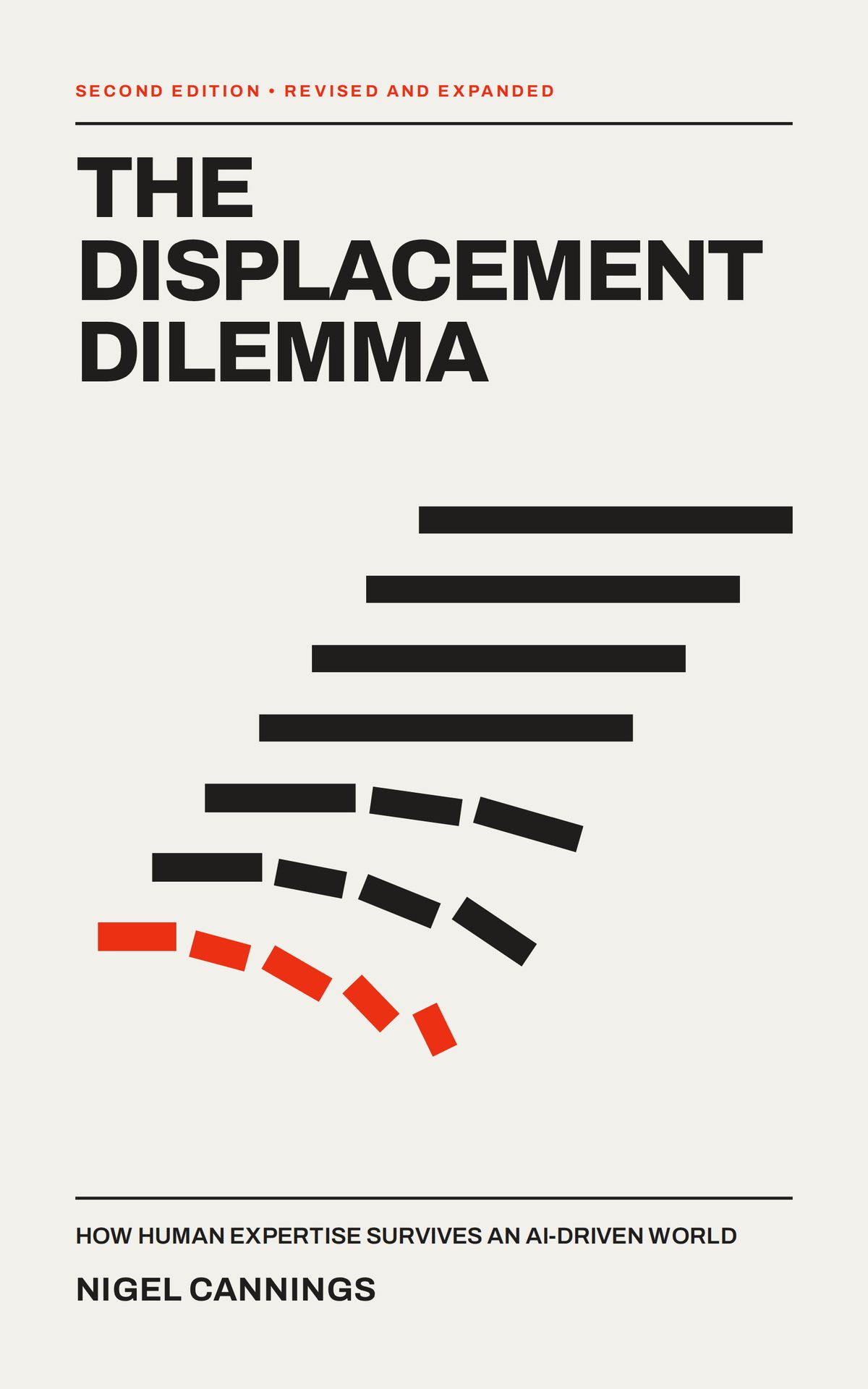
Second edition · Revised and expanded
“Wisdom is just time multiplied by mistakes.” AI is removing the chance to make them.
The Displacement Dilemma
How Human Expertise Survives an AI-Driven World
Kindle and paperback, both out now.
Buying from amazon.co.uk.
The link differs by country. Choose your Amazon store
What the book is about
AI promises to free us from dull, repetitive work. But that work is also how juniors learn, judgement develops and expertise is passed on.
In this extensively revised second edition, AI pioneer and former solicitor Nigel Cannings investigates what happens when the bottom rungs of the professional ladder disappear. Drawing on voices from law, medicine, finance, education, technology and the creative industries, he separates real progress from corporate AI-washing and asks the question too few organisations are facing: if machines do the work that makes us expert, where will the next generation of experts come from?
Grounded in two decades at the front line of NLP and AI, The Displacement Dilemma is a warning against careless automation, and a practical argument for preserving the human expertise on which every profession depends.
Who is in it
Sixteen people sat for interviews for this edition. The book’s credibility rests on them being real, so they are described here by what they do. Among them:
- A GP and novelist
- A consultant radiologist
- A board member and former Accenture executive
- Three practising lawyers, including the founder of the first AI-only law firm
- A professor of AI
- An architect
- A designer
- A psychotherapist
- A recruitment CEO
- A restructuring adviser
The four thousand word version
On my last read of the manuscript I asked an AI to summarise the whole book. It came back with four thousand words, about seven percent of the length, and every good bit was in there, which was very annoying. All the good anecdotes, and most of the jokes. And the writing, which is the part that stung, sounded more like me than I do.
So I refused to publish it, which is the sort of decision that feels principled for roughly a day.
The book says that if you reach the last page you can email me and I will send it on. I am extending that. Ask and you get it, whether you have bought the book or not.
It is not a download and it is not a mailing list. I read the message and I send the thing myself, which is slower, and is rather the point.
Ask for it
Your address is used to reply to you, and for whichever of the boxes above you ticked, and for nothing else. Nothing is shared with anybody. Ask at privacy@subbasement.press and it is deleted. How this is handled.
Or just email nigel@subbasement.press, which is what the book tells you to do.
Got it.
I answer these by hand, so it takes as long as it takes. Usually a day or two. Occasionally a week, if I am somewhere with bad wifi and good weather.
It will come from nigel@subbasement.press. If nothing has turned up in a while, have a look in your spam folder, and then chase me, because it will be my fault.
About the author

Nigel Cannings has spent over two decades at the intersection of AI, speech technology and the professions, mostly asking awkward questions about all three.
A former City lawyer, he crossed over to technology and stayed there. He is the named inventor on twenty-two granted patents in natural language processing, cryptography, AI and speech processing, and was the first to bring GPU technology to commercial speech recognition, in 2014, which led to work on explainable AI, AI ethics, secure search and confidential inferencing, long before those phrases appeared on conference lanyards. He founded Intelligent Voice, the speech and NLP provider to the financial sector, and ran it until its sale to Verint in October 2024, staying on with the acquirer until 2026, an experience that gave him both the material for the first edition of this book and, as the preface explains, the spare time to write a second edition.
He still works across law, finance and government. He combines advisory and research work with other roles, including being an Industrial Fellow at the University of East London, an AI Advisor to the All-Party Parliamentary Group on Balkan Trade and Security, a member of the Executive Committee of the National Security and Resilience Consortium, and an Industry Secondee at the Home Office’s Joint Security and Resilience Centre. He is the founder of Diplomatic Capital, a not-for-profit that promotes non-UK startups to the UK investment community. He is based in London.